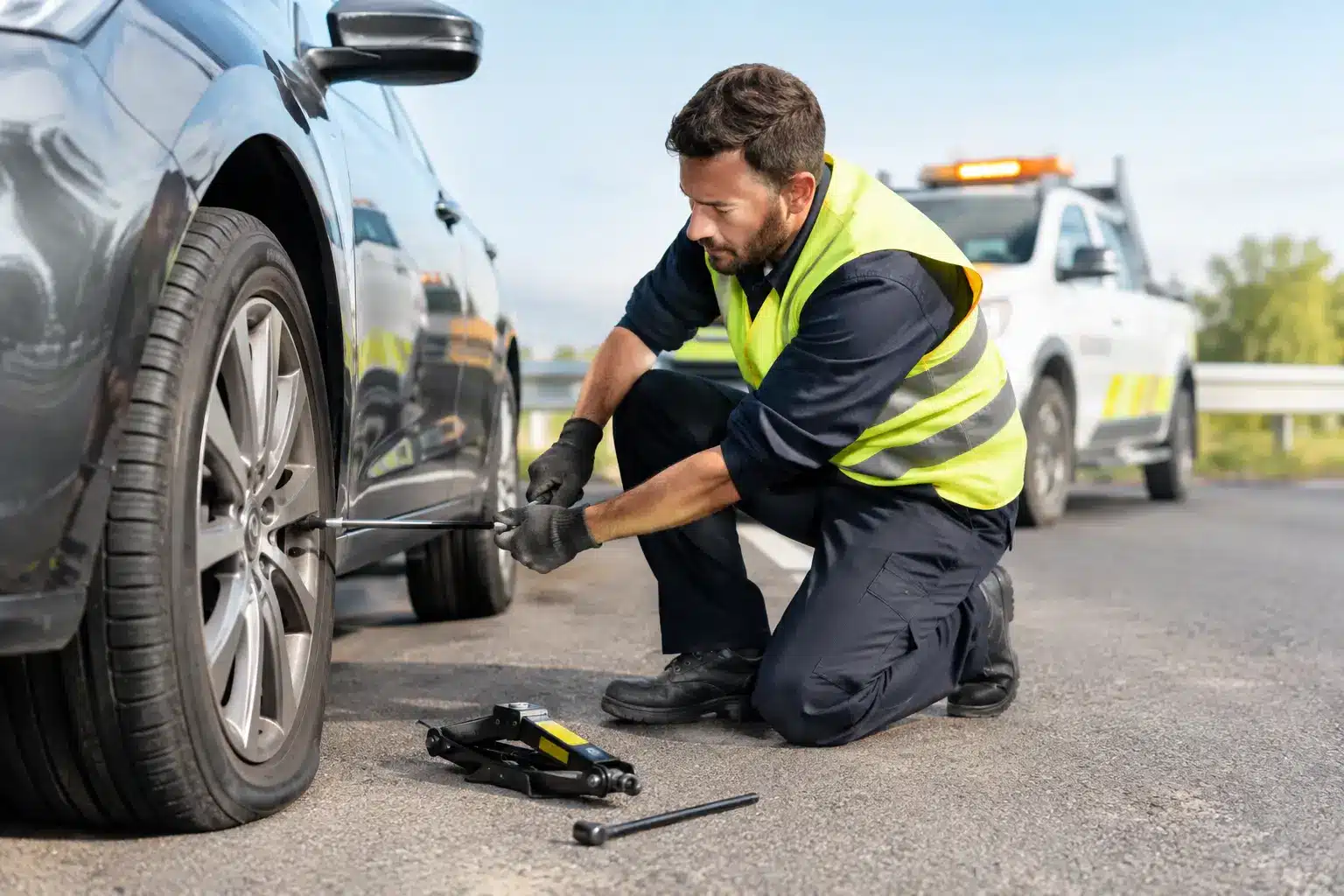
A puncture rarely happens at a convenient time. It may be on the school run, on the way to work, outside a customer visit or late at night on an unfamiliar road. Knowing how roadside assistance handles punctures can take some of the pressure out of the moment: the priority is to make the vehicle safe, assess the tyre properly and get you moving again where it is safe to do so.
For drivers in Camberley and the surrounding GU areas, the right response depends on more than whether a tyre looks flat. Where the vehicle is stopped, the extent of the damage, the type of vehicle and whether there is a usable spare all affect the safest next step.
Before work starts on a wheel, a trained technician will consider the location. A puncture on a quiet driveway is very different from one on a live carriageway, narrow country lane or busy roundabout approach. The vehicle needs to be positioned as safely as possible, with hazards managed before any tyre work begins.
If you suspect a puncture while driving, slow down steadily and avoid sharp braking or sudden steering. Pull over only where it is safe, switch on your hazard lights and move yourself and passengers away from traffic if the location allows. Do not stand next to the vehicle on the traffic side, and do not attempt a wheel change in an exposed or dangerous place.
When roadside assistance arrives, the technician will confirm the issue and decide whether a roadside tyre change is sensible. Safety comes before speed. If the vehicle cannot be worked on safely where it is, recovery to a safer location or tyre facility may be the better option.
The initial inspection is practical and quick. The technician checks whether the tyre has lost air through a nail, screw, valve fault, damaged wheel rim or a split in the tyre. They will also look for damage to the sidewall and assess whether the vehicle has been driven while the tyre was flat.
A small tread puncture is not always a simple fix at the roadside. A repair must be suitable, and any tyre that is badly damaged, worn beyond safe limits or compromised by being driven flat may need replacing. Roadside assistance is there to give you a safe solution, not a temporary answer that could fail a few miles later.
If your vehicle has a roadworthy spare wheel and the conditions are safe, the technician can normally fit it. They will remove the damaged wheel, fit the spare correctly and check that it is secure. You may then be advised to travel directly to a tyre specialist, particularly if the spare is a space-saver with a restricted speed or distance recommendation.
Some vehicles carry a tyre repair kit instead of a spare. These kits may help with certain small tread punctures, but they are not suitable for every type of damage. They will not solve a sidewall tear, a damaged rim or a tyre that has come away from the wheel. A technician can assess whether the kit is appropriate, rather than leaving you to rely on a sealant that may not be safe or effective.
A repair may be considered if the puncture is in the central tread area and the tyre has not sustained further internal damage. The exact decision rests with a tyre professional after inspection. A tyre can appear acceptable from the outside but be unsafe internally after being run at very low pressure.
This is why roadside support does not promise that every puncture can be repaired on the spot. In many cases, fitting the spare or arranging vehicle transport is the quickest way to protect the vehicle and get you away from the roadside. It also avoids unnecessary delays if a full inspection or replacement is required.
Tyres with sidewall damage, large cuts, bulges, exposed cords or severe wear should not be repaired. The same applies where the wheel itself is bent or cracked. Continuing to drive on any of these faults risks a blowout, loss of control and damage to the suspension or wheel.
Run-flat tyres can allow limited driving after pressure loss, but they still need checking. Their reinforced construction means the vehicle may remain controllable for a short distance, yet the tyre can be damaged beyond use if the permitted distance or speed is exceeded.
A roadside technician will not assume that a run-flat tyre is safe simply because the car is still moving. They will assess the warning signs, tyre condition and your options. Depending on the damage, recovery may be the safest route.
Modern cars and vans are increasingly supplied without a spare wheel. The available space may be used for a repair kit, battery equipment or storage, while manufacturers also reduce weight where possible. That can be frustrating when a puncture leaves the vehicle immobile, but it does not mean you are stranded without a solution.
Where there is no usable spare, no suitable repair, or the damaged tyre cannot safely be changed at the roadside, a recovery vehicle can transport your car or van to a tyre centre, home address, garage or another agreed destination. This is particularly useful outside normal tyre shop hours, after a long day at work or when you are carrying passengers, tools or goods.
For van drivers, the load and vehicle size may influence the recovery plan. A heavily laden van, a vehicle with specialist tyres or one stopped in a difficult location may need dedicated transport rather than a basic roadside repair. The aim is to move the vehicle safely without creating further damage or delay.
When you call for help, clear information helps the recovery team send the right vehicle and equipment. Explain your exact location as accurately as possible, including a road name, nearby landmark, postcode or motorway marker. Let the operator know whether you are in a safe place and whether the tyre is completely flat.
It also helps to mention the vehicle make, model and registration, whether you have a spare wheel, and if the vehicle is a car or van. If you can see a nail in the tyre, leave it in place. Removing it can cause rapid air loss and makes the situation harder to manage safely.
If you are on a smart motorway, motorway hard shoulder or another high-speed road, tell the operator immediately. These locations require additional care and may affect how the vehicle is recovered. Do not wait beside the vehicle unless there is no safer alternative.
A roadside tyre change is usually the fastest option when there is a sound spare, a safe working area and no indication of wider damage. It gets you back on the road, although often only for a limited journey. It is a practical solution, not a substitute for having the damaged tyre checked or replaced promptly.
Full recovery is more appropriate when the tyre is beyond use, there is no spare, multiple tyres are damaged, wheel damage is suspected or the roadside location is unsafe. It can feel like the longer option, but it is often the quicker overall answer compared with attempting an unsuitable repair, waiting for a mobile fitter or risking further vehicle damage.
K & D Transport provides 24/7 roadside assistance and vehicle recovery for puncture situations where a safe tyre change or onward transport is needed. Whether you are stuck locally or need a broader recovery solution, the focus is on getting the right help to you without unnecessary complication.
Driving even a short distance on a flat tyre can damage the tyre sidewall, wheel rim and suspension components. If the steering feels heavy, the car pulls to one side, or you hear repeated flapping or thudding, stop as soon as it is safe. Do not try to reach a garage if doing so means driving on a fully deflated tyre.
After a spare has been fitted, follow any speed restrictions and arrange a proper tyre inspection as soon as you can. Check the spare's condition periodically too. A spare that has lost pressure, is perished or has insufficient tread will not be a reliable emergency option when you need it.
A puncture is disruptive, but it does not need to turn into a longer roadside emergency. Get to a safe position, give clear location details and let a trained recovery team decide whether a tyre change, temporary solution or vehicle transport will get you moving safely.

