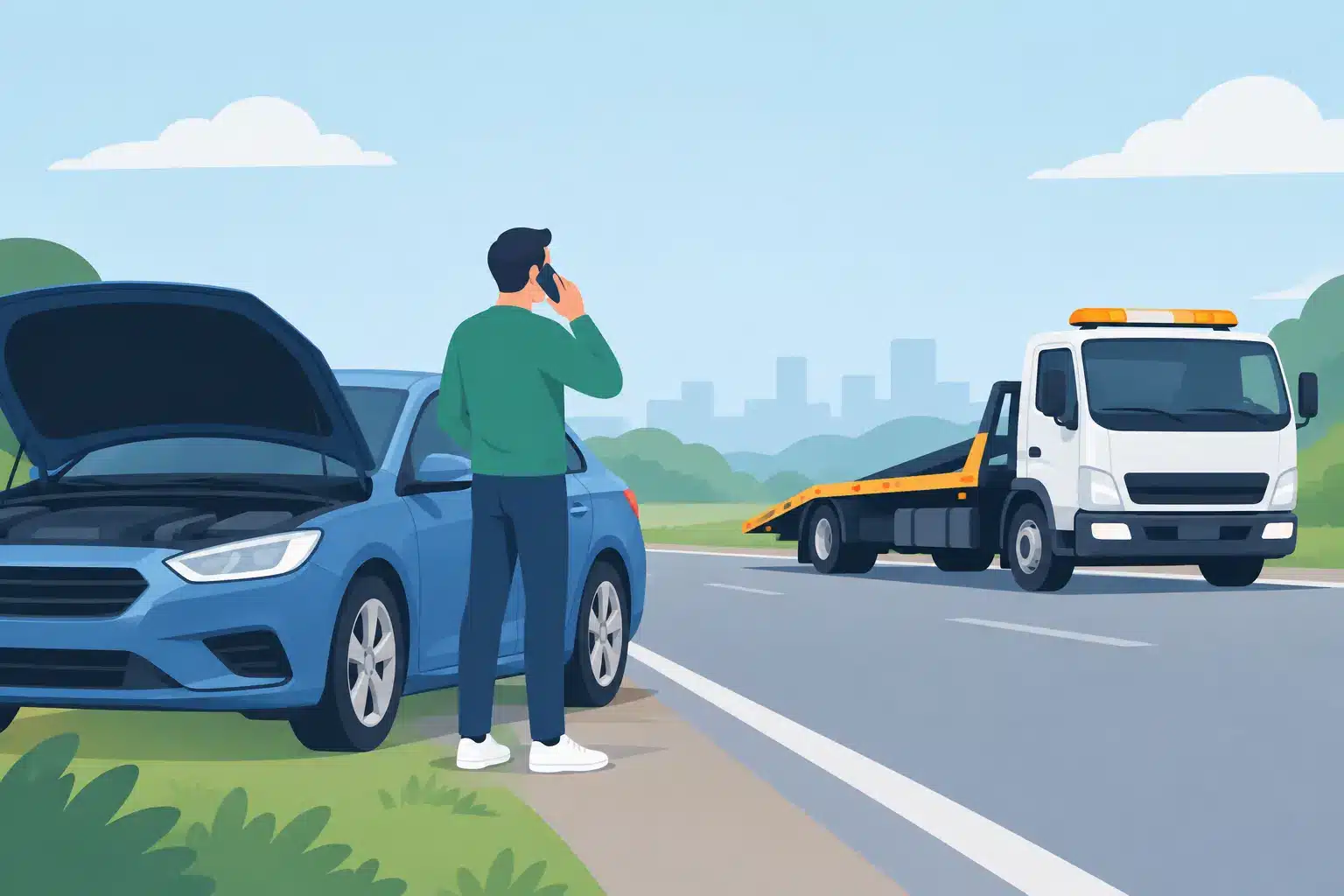
A breakdown rarely gives you a convenient warning. You may be on the school run, heading to work, carrying tools in a van or stopped on a dark road with no safe place to wait. Knowing how to request vehicle recovery before the stress takes over helps the recovery team reach you faster and send the right vehicle for the job.
The first priority is always your safety. Once you and your passengers are in the safest practical position, contact a professional recovery service and give clear information about where you are, what has happened and what vehicle needs help. You do not need to diagnose the fault. A reliable recovery operator will ask the right questions, arrange the appropriate response and keep the process straightforward.
If your vehicle can be moved, get it away from moving traffic and into a safe, legal place. Switch on your hazard warning lights. At night, in poor weather or on a fast road, make your vehicle as visible as you safely can.
On a motorway, follow motorway safety guidance. If you can reach an emergency refuge area or leave at the next exit without creating further danger, do so. If the vehicle is stopped in a live lane and you can leave it safely, move behind a barrier and away from traffic. Do not attempt roadside repairs where passing vehicles put you at risk.
If you are stranded with children, elderly passengers, pets or someone who needs medical assistance, say so when you request recovery. This can affect how the incident is handled and whether you need urgent support from the emergency services as well as a recovery vehicle.
Start by calling a 24/7 vehicle recovery provider. Explain that you need recovery, towing, roadside assistance or a jumpstart, depending on the situation. If you are unsure which service applies, simply describe the problem. For example, a vehicle that will not start may need a battery jumpstart, while a car with a warning light, tyre damage or mechanical fault may need transport to a garage or home address.
Stay calm and speak slowly. The call handler needs usable information, not a perfect explanation. Giving accurate details at the beginning avoids delays, prevents the wrong recovery equipment being sent and helps the driver find you without unnecessary back-and-forth.
Have your mobile phone charged where possible and keep it nearby after your request has been logged. If your location changes, if the police attend, or if you manage to move the vehicle to a safer spot, update the recovery provider straight away.
Your location is often the most important part of the call. A postcode is helpful, but it is not always enough, particularly on rural roads, dual carriageways and motorways. Use your phone map to identify the nearest road name, junction, roundabout, bridge, landmark or business.
On motorways and major A-roads, look for marker posts and note the road number, direction of travel and the nearest junction. If you are near a service station, lay-by or petrol station, give its name. In Camberley and the surrounding GU postcode areas, a street name and postcode may be sufficient, but clear landmarks still make dispatch quicker.
If you cannot identify your location, tell the operator what you can see and where you were travelling from and to. Never walk along a live carriageway to find a sign.
A short description lets the recovery team prepare properly. Say whether the engine will start, whether there has been a collision, whether a tyre has failed, whether warning lights are showing, or whether the vehicle is stuck, overheating or making unusual noises.
Be honest about the condition of the vehicle. If it is in a ditch, locked in park, has damaged wheels, cannot roll freely or has been involved in an accident, mention it. These details may mean a standard tow is not appropriate and a different recovery method is needed.
You should also say whether the vehicle is blocking a driveway, loading bay, access road or traffic lane. A vehicle creating an obstruction may need more urgent attendance, but safety and local authority or police instructions always come first.
Give the registration number, make, model and colour of your car or van. Let the operator know if it is electric, hybrid, automatic, lowered, heavily loaded or carrying passengers. A van recovery may require different equipment and planning from a small car, especially if it contains tools, goods or racking.
Next, confirm where the vehicle needs to go. This might be a local garage, your home, a dealership, a safe storage location or another UK address. If you do not know the destination yet, tell the operator. The recovery team may be able to take the vehicle to a suitable local location, depending on availability and the circumstances.
Ask whether you can travel with the recovery vehicle if that matters to you. It often depends on the number of passengers, the recovery vehicle, the route and safety requirements. Do not assume there will be space without checking.
Not every breakdown needs a full recovery. If the issue is a flat battery, a trained technician may be able to provide a jumpstart and get you moving again. A minor problem may also be resolved at the roadside if it is safe and practical to do so.
However, towing is usually the better option when the vehicle has a serious mechanical fault, collision damage, an overheating engine, repeated starting failure or an issue that makes driving unsafe. Continuing your journey because the car starts again can turn a manageable fault into expensive damage. If you are unsure, choose safety and ask for professional advice.
There is also a practical trade-off. Roadside assistance may get you back on the road sooner, but only where the vehicle is safe to drive. Recovery and transport take longer than a jumpstart, yet they remove the risk of being stranded again a few miles later.
Before the vehicle is collected, confirm the expected attendance time, the type of assistance being sent and the destination. Ask how payment is handled and whether there are additional charges for distance, difficult access, out-of-hours attendance or specialist recovery requirements.
If your vehicle is under warranty, covered by a manufacturer scheme, fleet policy or breakdown membership, check whether you need to contact that provider first. In an urgent situation, you may still need immediate help, so do not delay if you are in an unsafe location.
Take photographs of the vehicle before it is loaded if it has existing damage or has been involved in an incident. Remove valuables, important documents, medication and personal belongings where safe to do so. If you leave keys with the driver, make sure the destination and contact details are confirmed.
Keep yourself visible but protected from traffic. Stay well clear of moving vehicles and do not stand between your vehicle and the road. Avoid accepting help from strangers who suggest towing your vehicle with a rope or trying repairs you are not comfortable with.
Keep your phone available for the recovery driver. If you are in a vulnerable position, such as on an isolated road at night, tell the call handler and contact someone you trust. Where there is immediate danger, an injury or a serious collision, call the emergency services first.
A professional recovery team should give you clear instructions, arrive with suitable equipment and handle your vehicle carefully. K & D Transport provides 24/7 roadside assistance, car and van recovery, towing, transport and jumpstart support for drivers who need practical help without delay.
When your vehicle lets you down, focus on getting safe rather than trying to solve everything at the roadside. Give a recovery provider your location, vehicle details and a simple account of the fault, then let trained professionals get you and your vehicle to a safer place.

