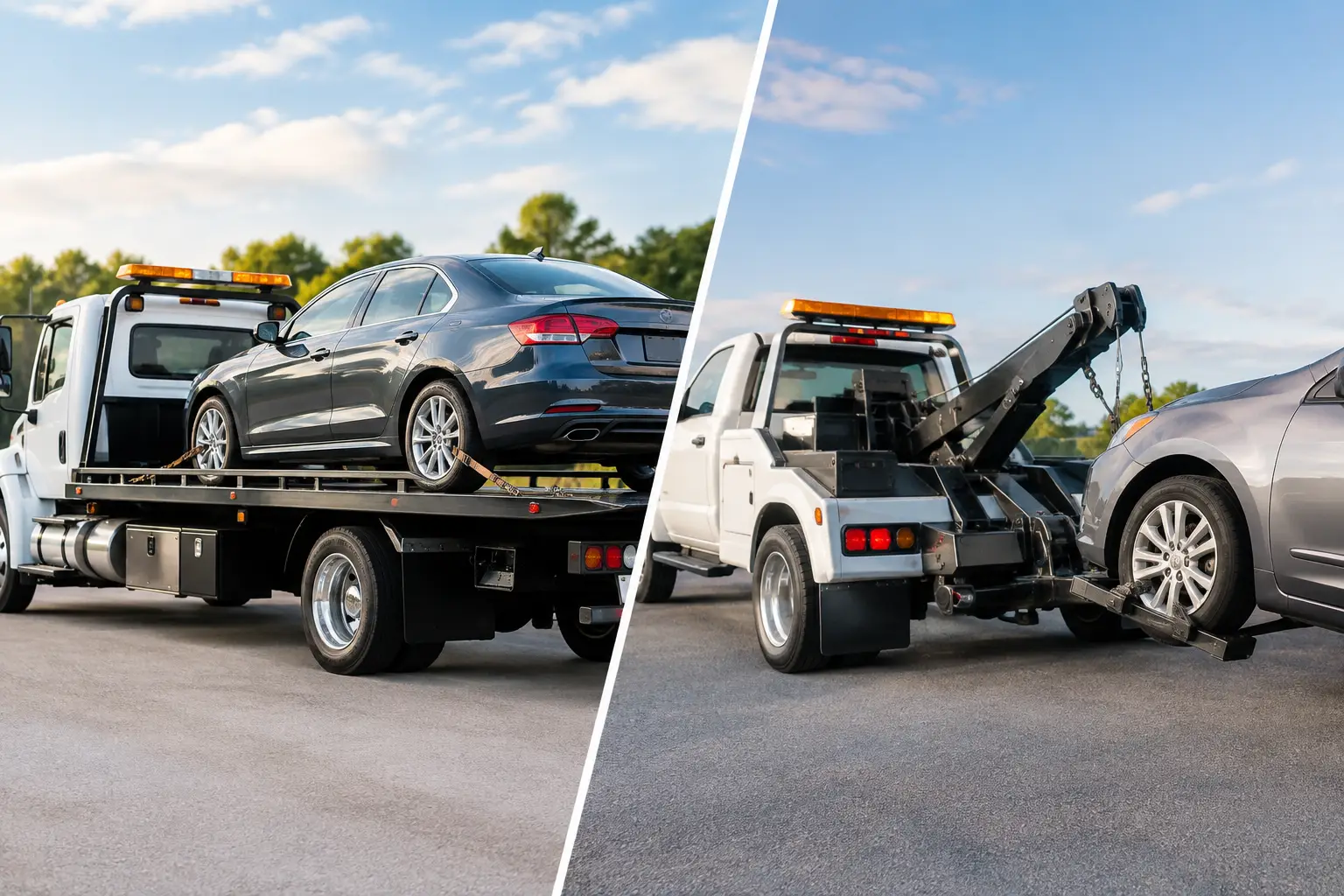
A breakdown is not the time to work out whether your vehicle needs a flatbed versus wheel lift recovery. You need a safe collection, clear advice and a recovery vehicle that is right for the condition of your car or van. The method matters because the wrong type of tow can cause further damage, particularly after an accident, a mechanical failure or a drivetrain fault.
At K & D Transport, the priority is getting you and your vehicle recovered safely, whether you are stranded locally in Camberley and the GU area or need onward transport further across the UK. Here is what separates flatbed and wheel lift towing, and when each option is usually the safer choice.
A flatbed recovery vehicle carries your whole car or van off the road. The vehicle is loaded onto a level platform, secured in place and transported without its wheels rolling on the road. This is often called full lift recovery.
A wheel lift raises either the front or rear wheels while the other pair remains on the road. The recovery vehicle then tows the vehicle behind it. It is a practical and efficient option for many standard recoveries, especially when access is limited or a quick roadside collection is needed.
Neither method is automatically better in every situation. The right choice depends on the vehicle, the fault, its position, the distance involved and whether it can safely roll and steer.
Flatbed transport gives the highest level of protection because all four wheels are off the ground. It is the preferred choice when driving or towing the vehicle on any of its wheels could worsen the problem.
After a collision, damage is not always obvious. A wheel may be bent, a tyre may be damaged, suspension components may have moved, or fluid may be leaking. Even if the vehicle appears to roll, towing it with two wheels on the road could put stress on damaged parts.
A flatbed allows the vehicle to be loaded and secured with minimal movement. This is usually the sensible option for cars and vans with accident damage, damaged steering, suspension issues or a wheel that is not sitting correctly.
Many electric vehicles, hybrids and four-wheel-drive models need particular care during recovery. Their drivetrains can be affected if the wrong wheels are left turning during a tow. Some vehicles can only be moved with all wheels off the ground, while others have manufacturer-specific procedures.
For that reason, a flatbed is often the safest answer for electric, hybrid, automatic and four-wheel-drive vehicles. The recovery team will assess the vehicle before loading it, rather than making assumptions based on its appearance.
Low cars can catch on ramps or scrape underneath if loading angles are too steep. Prestige vehicles, classics and modified cars may also need extra care because of reduced ground clearance, bodywork condition or specialist components.
A properly equipped flatbed recovery offers more control during loading and transport. It is particularly useful when the vehicle has a low front bumper, sports suspension, a damaged tyre or bodywork that needs protecting.
If your vehicle needs to go to a garage, home address, dealership or another location some distance away, flatbed transport is often the more secure choice. No wheels are turning, no mileage is added through towing and there is less exposure to road debris or further mechanical strain.
This also makes flatbeds ideal for non-running vehicles, vehicles being bought or sold, and cars that need moving without being driven.
Wheel lift towing remains a useful recovery method. It can be faster to position in tight places and is well suited to vehicles that are safe to tow with one axle raised.
For a straightforward breakdown where a front-wheel-drive or rear-wheel-drive vehicle is intact, rolling freely and has no drivetrain or steering damage, a wheel lift can be an efficient solution. It is commonly useful for short local recoveries, roadside removals and locations where a larger flatbed cannot easily manoeuvre.
A wheel lift can also be the practical choice when a car is parked in a confined space, on a narrow residential road or in a car park with limited access. The recovery operator still needs enough room to work safely and must make sure the vehicle can be secured correctly before it is moved.
The key point is that wheel lift towing is not a shortcut. It is a suitable method only when the vehicle’s condition and manufacturer guidance allow it.
When you contact a recovery company, the details you provide help determine whether a flatbed or wheel lift is needed. You do not need technical knowledge. A clear description of what happened is enough.
Tell the operator whether the vehicle starts, whether it can roll, if any tyres are flat, whether there has been an accident and if warning lights or fluid leaks are present. Mention if it is electric, hybrid, automatic or four-wheel drive. If the wheels are locked, the steering will not turn or the vehicle is in an awkward position, say so before dispatch.
The location also matters. A vehicle stopped on a busy road, at the roadside, in a multi-storey car park or down a narrow lane presents different access and safety issues. The recovery team can then send the most appropriate vehicle and equipment rather than arriving unprepared.
When you are stranded, it is understandable to want the quickest and lowest-cost tow available. But a recovery that is unsuitable for your vehicle can become expensive very quickly. Damage to a gearbox, transfer case, tyres, suspension or bodywork may leave you with a bigger repair bill than the original fault.
The best recovery method is the one that protects the vehicle and gets it where it needs to be without adding risk. A professional operator will consider the drivetrain, the condition of the wheels, how the vehicle is positioned and the destination before deciding how to move it.
This is especially relevant if a garage has told you not to drive the vehicle, if the vehicle has failed suddenly at speed or if it has been involved in a collision. In these cases, full flatbed recovery is often the cautious choice.
Your safety comes first. If you can do so safely, move away from moving traffic and switch on your hazard warning lights. Do not attempt to push a vehicle on a live road or stand between your vehicle and passing traffic.
Keep your phone available, note your location as accurately as possible and have the registration, make and model ready. If you are on a motorway or a dangerous stretch of road, follow the relevant road safety guidance and make the recovery operator aware of the risk.
Avoid trying to force a damaged vehicle to move. A car that will not select gear, has a locked wheel or has suffered impact damage may need specialist handling. Waiting for the right recovery vehicle is safer than creating a second problem at the roadside.
Flatbed versus wheel lift is not just a question of equipment. It is a decision about protecting your vehicle, keeping the roadside safe and avoiding avoidable damage. A standard, undamaged vehicle may be suitable for wheel lift towing, while a damaged, low-clearance, electric or four-wheel-drive vehicle will often be better carried on a flatbed.
When you need help, give a clear account of the fault and your location, then let an experienced recovery team choose the safest method. That small check at the start can make a stressful breakdown far easier to manage.

